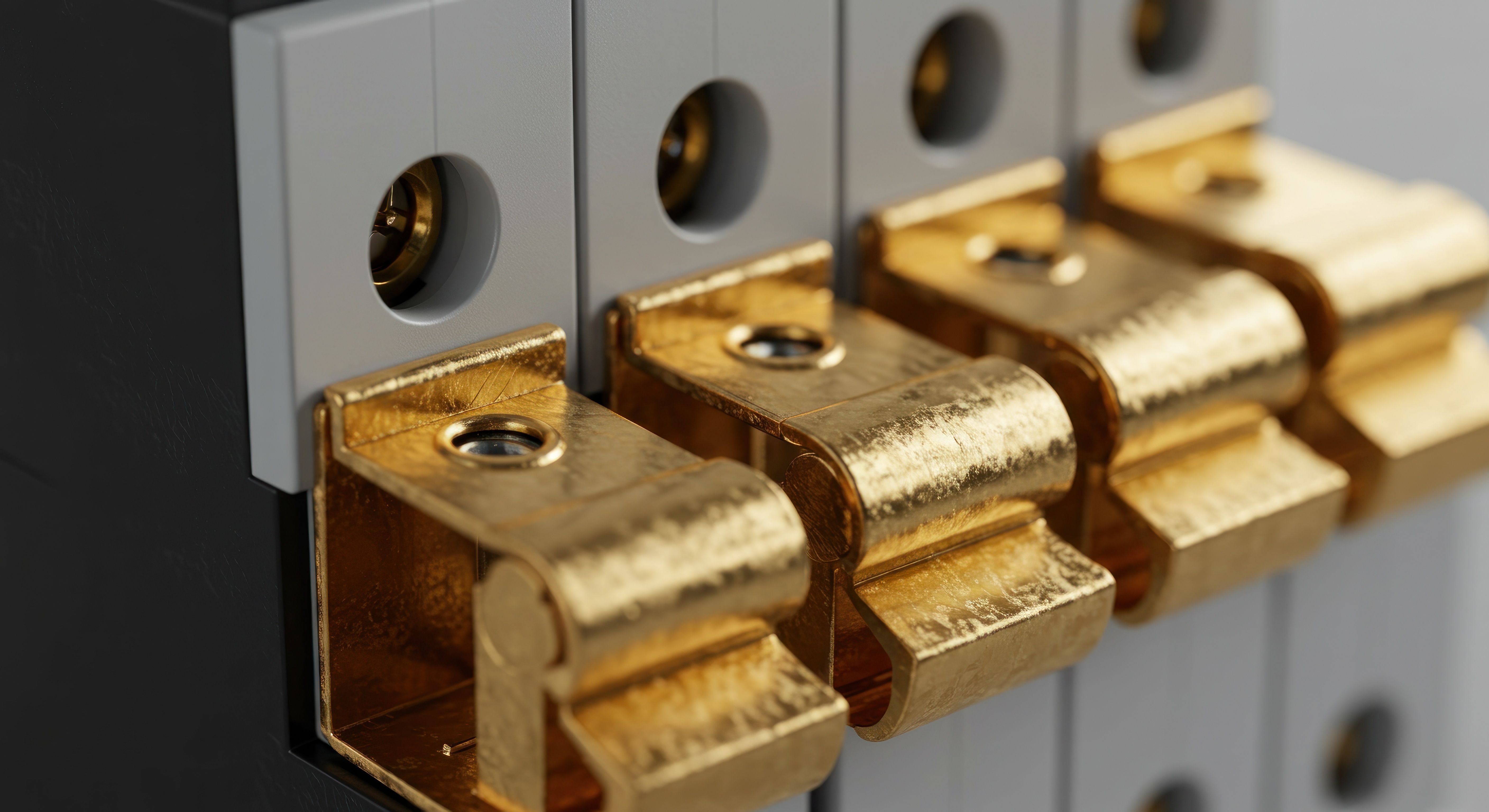
What Causes Contact Resistance in Electrical Contacts?
Understanding One of the Most Important Factors in Electrical System Reliability
Electrical contacts are found throughout modern power distribution systems, from circuit breakers and switchgear to automatic transfer switches, substations, energy storage systems, EV charging infrastructure, and industrial control equipment.
While electrical contacts may represent only a small portion of an electrical system, their performance often determines the reliability, efficiency, and service life of the entire assembly.
One of the most important measures of contact performance is contact resistance.
What Is Contact Resistance?
Contact resistance is the resistance to current flow at the interface between two conductive surfaces.
Although contact materials may be highly conductive, the actual contact area between two mating surfaces is much smaller than it appears. Microscopic surface roughness, oxides, contaminants, and material deformation all influence the efficiency of current transfer across the contact interface. These principles are foundational to electrical contact design and performance, and are covered in depth in Paul G. Slade’s Electrical Contacts: Principles and Applications. [1]
When contact resistance increases, electrical energy is converted into heat rather than being transferred efficiently through the circuit.
Why Contact Resistance Matters
Even small increases in contact resistance can have significant consequences in high-current applications.
Potential effects include:
- Increased operating temperatures
- Reduced system efficiency
- Accelerated contact wear
- Surface oxidation
- Material degradation
- Premature equipment failure
In power distribution systems carrying hundreds or thousands of amps, maintaining low and stable contact resistance is critical to long-term reliability, thermal performance, and safe operation. IEEE’s industrial and commercial power systems standards collection provides guidance across power system design, reliability, and operation. [2]
Common Causes of Contact Resistance
Contact Surface Oxidation
Many conductive materials naturally form oxide layers when exposed to the environment.
These oxides can reduce conductivity at the contact interface and increase resistance over time.
Silver-based contact materials are frequently used because silver oxide remains conductive, helping maintain stable electrical performance in demanding applications.
Surface Contamination
Dust, moisture, oils, and other contaminants can interfere with metal-to-metal contact.
Environmental conditions often play a significant role in determining long-term contact performance, particularly in utility, industrial, transportation, and energy infrastructure applications.
Contact Wear and Arc Erosion
Repeated switching operations expose contacts to electrical arcing.
Over time, arcing can:
- Remove contact material
- Alter contact geometry
- Increase surface roughness
- Raise contact resistance
Material selection becomes increasingly important in applications that require frequent switching cycles or the interruption of high fault currents. Arc erosion remains one of the primary mechanisms affecting contact life and long-term electrical performance. [1]
Insufficient Contact Force
Electrical contacts rely on mechanical force to create reliable conductive pathways.
If contact pressure decreases due to wear, relaxation, vibration, or improper design, the effective contact area decreases and resistance increases.
How Contact Materials Influence Performance
Material selection is one of the most important factors affecting contact resistance.
Different applications require different combinations of conductivity, arc resistance, mechanical strength, and environmental durability.
Common contact materials include:
Silver Tin Oxide
Widely used for switching applications requiring strong resistance to welding and arc erosion.
Silver Tungsten
Provides exceptional performance in high-current and fault-current environments where arc resistance is critical.
Silver Nickel
Offers a balance of conductivity, durability, and switching performance.
Copper-Based Systems
Frequently used where high conductivity and efficient current transfer are primary requirements.
The selection of contact materials directly influences resistance stability, switching life, thermal behavior, and overall system reliability. IEEE’s Technical Committee on Electrical Contacts focuses on electrical contacts, connectors, and interconnection technologies, reflecting the continuing importance of material and interface performance in electrical systems. [3]
Contact Resistance in Bus Bar Systems
As power distribution systems become larger and more complex, bus bar assemblies play an increasingly important role in managing and distributing electrical energy.
Integrated electrical contacts within bus bar assemblies help reduce the number of connection points, improve current transfer, and enhance overall system reliability.
Applications include:
- Utility switchgear
- Transformer disconnects
- Automatic transfer switches
- Energy storage systems
- EV charging infrastructure
- Data center power distribution
In these applications, both contact performance and bus bar design contribute directly to system efficiency, thermal stability, and long-term operating reliability.
Engineering Performance at the Contact Interface
Reliable electrical performance begins at the contact interface.
The combination of contact material selection, geometry, manufacturing precision, and assembly design ultimately determines resistance, durability, and service life.
As utilities, OEMs, and infrastructure providers continue modernizing the electrical grid, maintaining low contact resistance remains one of the most important requirements for safe, efficient, and reliable power distribution.
Related Resources
- Electrical Contacts
- Contact Materials
- Copper Bus Bars with Integrated Electrical Contacts
- Energy & Power Grid Applications
Further Reading
[1] Paul G. Slade, Electrical Contacts: Principles and Applications, Second EditionA foundational technical reference covering electrical contact theory, contact resistance, arc erosion, degradation mechanisms, and switching performance.https://www.routledge.com/Electrical-Contacts-Principles-and-Applications-Second-Edition/Slade/p/book/9781138077102
[2] IEEE 3000 Standards Collection for Industrial & Commercial Power SystemsIEEE’s standards collection covering industrial and commercial power system design, reliability, and operation.https://standards.ieee.org/products-programs/ieee-3000/
[3] IEEE Technical Committee on Electrical ContactsThe IEEE technical committee focused on electrical contacts, connectors, and interconnection technologies.https://www.ewh.ieee.org/soc/cpmt/tc1/
Additional Links
Electrical Contacts in MV & HV Power Circuit Breakers
Contact Information
For more information, contact:
Cody Piepenbrink Director, Business Development
Checon Headquarters & Primary Manufacturing
piepenbrink@checon.com